
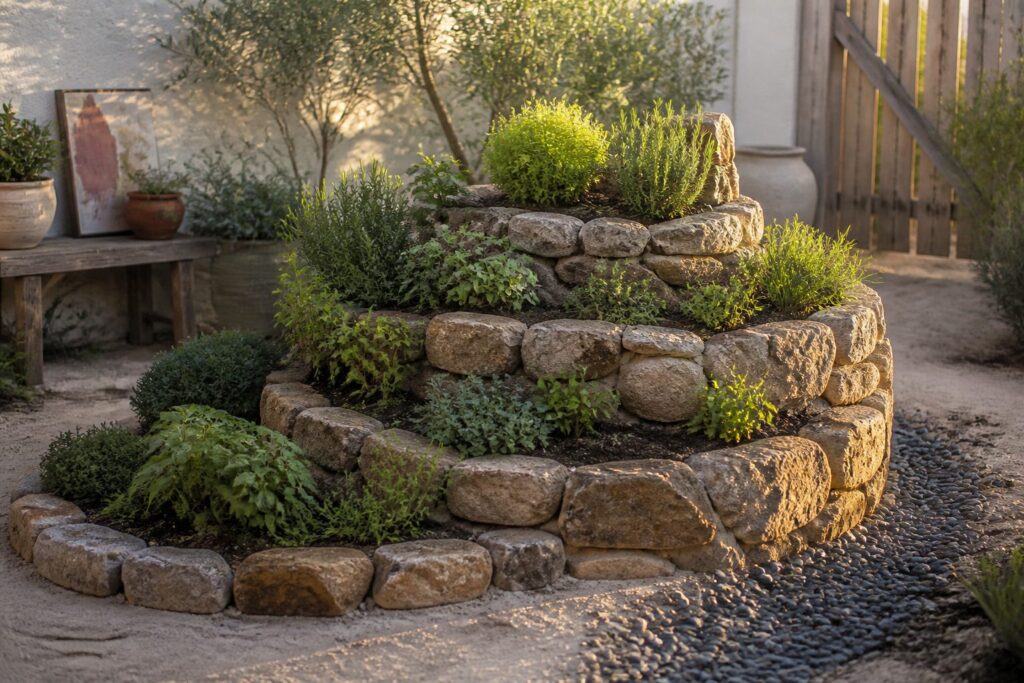
An herb spiral garden is a raised bed built in a rising coil of stone or brick, creating dry soil at the top and damp shade at the bottom in a space barely wider than a patio table.
It only works if you place it within arm’s reach of the door you use most; a spiral tucked behind the garage gets ignored by mid-July.
Start by tying a string 2.5–3.25 feet from a center stake to mark the spiral’s path in soil or flour.
[link-whisper-related-posts]Choose a Location
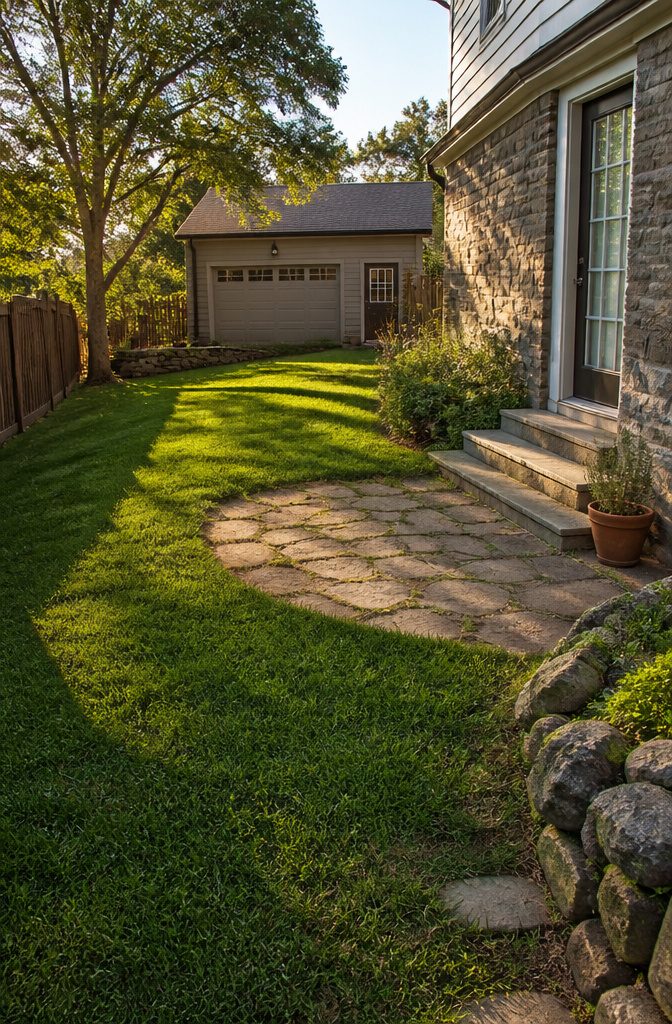
Six hours of direct sun is the line between herbs that thrive and herbs that merely survive.
Most culinary varieties, rosemary and basil included, need that stretch of light to develop the oils that make them worth growing. Less than that, and you are forcing shade-tolerant exceptions into a structure built for sun lovers.
Proximity to the kitchen matters more than gardeners admit. An herb spiral tucked behind a garage or at the far end of a yard gets ignored by mid-July.
The spiral shape already condenses a lot of plants into arm’s reach; wasting that advantage on a ten-minute walk defeats the point.
I would place it just outside the door I use most, close enough that snipping thyme for eggs does not feel like a project.
Give your spiral at least five hours of direct sun; six is even better if you want the widest choice of herbs.
My call is to aim for six and treat five as the floor you settle for only if the kitchen door spot happens to land there.
Level ground helps, too, though that matters more when you start stacking stone than it does now.
This choice, sun plus access, is the one that shapes every planting decision after. Get it wrong and you are managing decline instead of harvesting.
Mark the Spiral
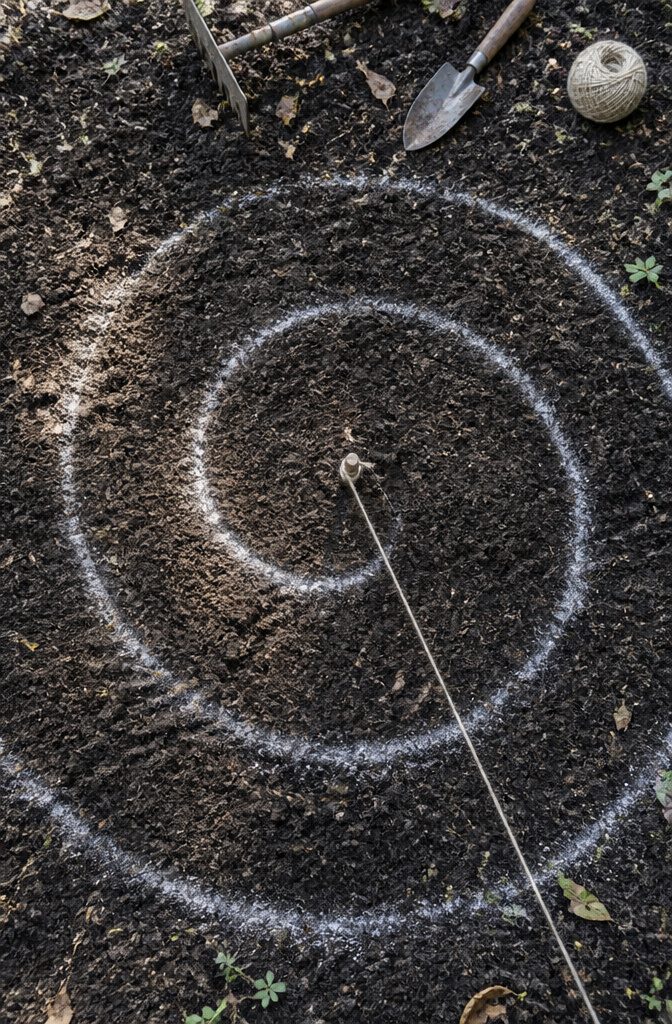
The string length sets the whole thing in motion. For a spiral that finishes at 5–6.5 feet across, tie your string 2.5–3.25 feet from the center stake and walk the circle, scratching the line into soil or mulch with a second stake.
Flour or powdered lime works too if you want a cleaner mark to follow.
That same layout automatically builds the height you need.
As the spiral climbs to about 3 feet at the center, it creates the microclimates that make the structure worth building: drier ground up top, wetter soil at the bottom, a gradient in between.
I would decide right now which herbs need which conditions, because the spiral shape locks those zones in place before you stack a single stone.
Each arm of the spiral should run about 1–1.5 feet across. Any narrower and you lose the planting room that justifies the work; much wider and the bed stops reading as a spiral at all.
Build the Base
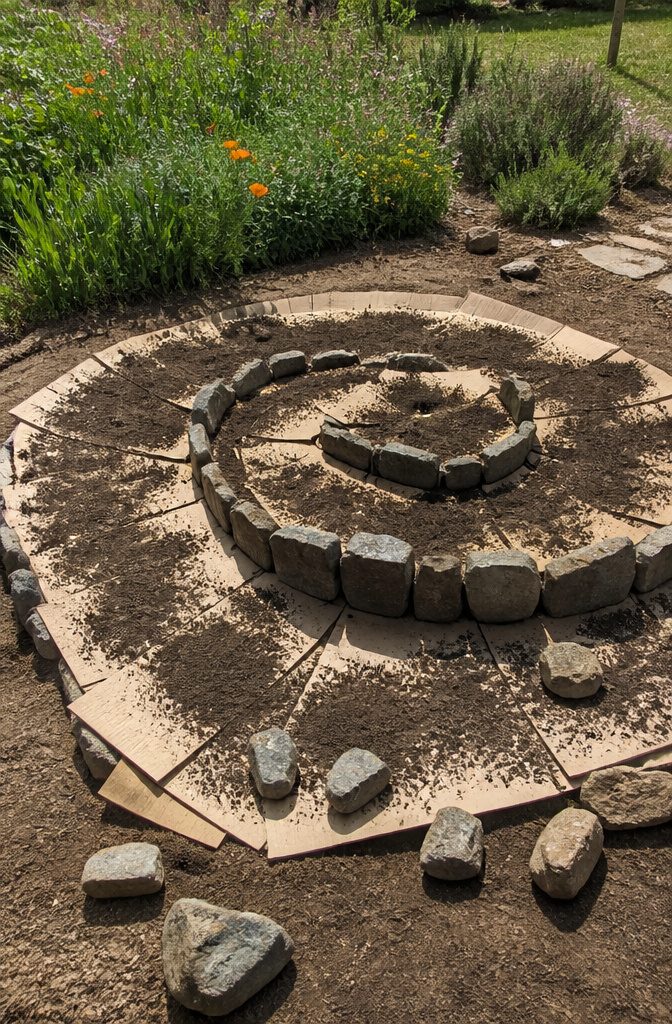
Cardboard laid over the footprint of your spiral stops weeds without the cost of landscape fabric.
Overlap the edges so no light slips through, soak it with a hose so it stays put, and it will break down into carbon that feeds the soil.
Some gardeners tuck vegetable scraps or green waste underneath to speed that decomposition along.
From there, you build the wall. Start your stones or bricks along the outer edge and spiral inward, keeping the planting bed about 0.5 m, or roughly 1.6 ft, wide.
The outside ring stays lowest, maybe one or two stones high, and you stack higher as you move toward the center.
Dry stone wall technique wins here for a weekend project. Rocks or bricks overlap for stability, and you can backfill with soil as you go to hold everything in place.
Mortar or cement gives a cleaner look but adds cost, curing time, and the hassle of mixing. For most renters and first-home owners, the dry stack is the smarter trade.
Before any soil goes in, drop a layer of rubble, gravel, or broken pottery at the bottom of each section. That drainage layer keeps roots from sitting wet, especially in the lower zones where water naturally collects.
Fill with Soil
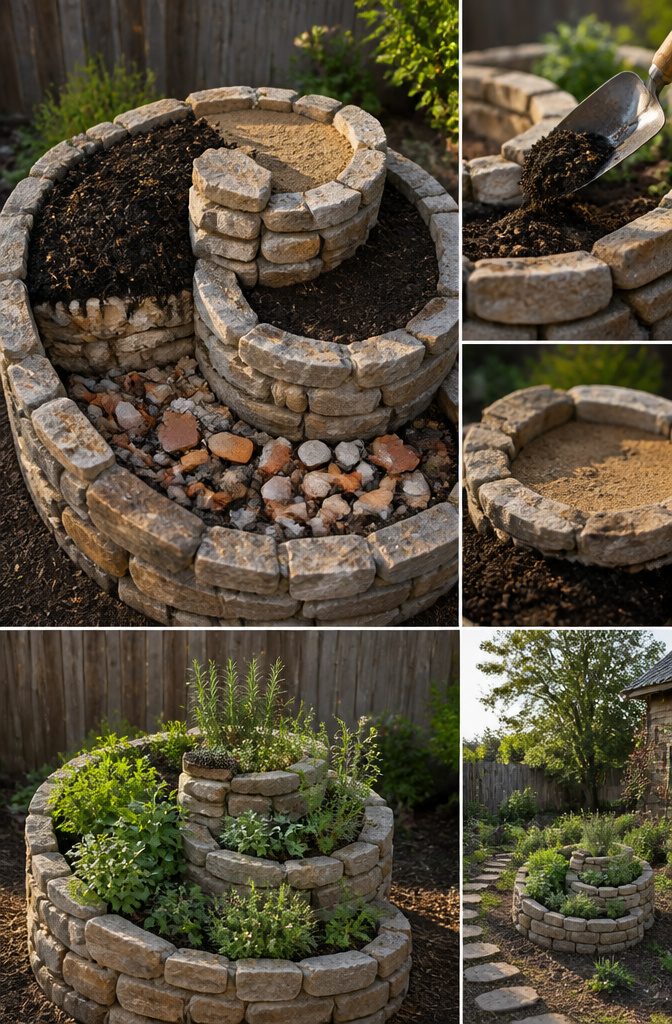
The base layer matters more than the mix above it. I start every herb spiral with coarse material at the bottom: rubble, gravel, or broken pottery scraps work fine.
This keeps the lower sections from turning into a bog after heavy rain, since water naturally pools there before it drains away.
From there, I build upward with soil, compost, and whatever organic matter I have on hand.
Some gardeners layer in small logs, sticks, and leaves to fill the deepest areas and cut down on how much soil you need to haul.
Others keep it simpler with just garden soil and compost. A handful of sand or perlite near the top helps water move through faster where the Mediterranean herbs will live.
No source I trust pins down exact ratios, and I would not pretend to know them. What I have found: if the soil settles after the first watering, which it usually does, you simply add more and tamp it lightly.
Before planting, I work in about an inch of compost across the surface. The spiral is forgiving; getting precious about percentages misses the point.
Plant Herbs
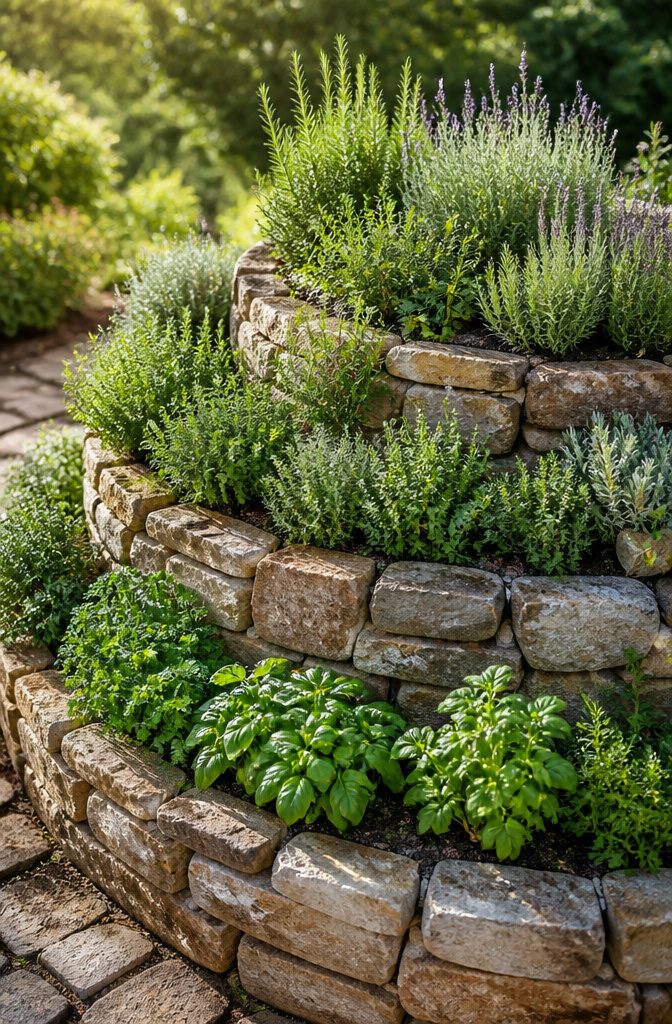
The top of the spiral is where water drains fastest and sun hits hardest, so this is where rosemary, thyme, oregano, sage, and lavender belong.
These Mediterranean herbs want dry feet and full exposure; tucking them lower wastes the shape’s logic and leaves you with leggy, unhappy plants.
Midway down the slope, moisture lingers longer and some afternoon shade creeps in.
Basil, parsley, dill, and chives settle here nicely. They need steady water but still want decent light, and the spiral’s curve gives them exactly that middle ground.
The base stays coolest and dampest, sometimes with shade from the spiral’s own walls. Mint, cilantro, lemon balm, and watercress thrive here, though mint needs a pot sunk into the soil or it will own the whole structure by July.
I would skip planting it directly in the bed entirely; the containment is never as complete as you think.
What you gain from this arrangement is not just healthy plants but a garden that waters itself in a rough way.
Rain runs down and pools where the moisture-lovers wait, while the apex dries out fast enough to keep roots from rotting. Rainwater runs downhill through the soil and stone, so the spiral waters itself.
Mulch and Water
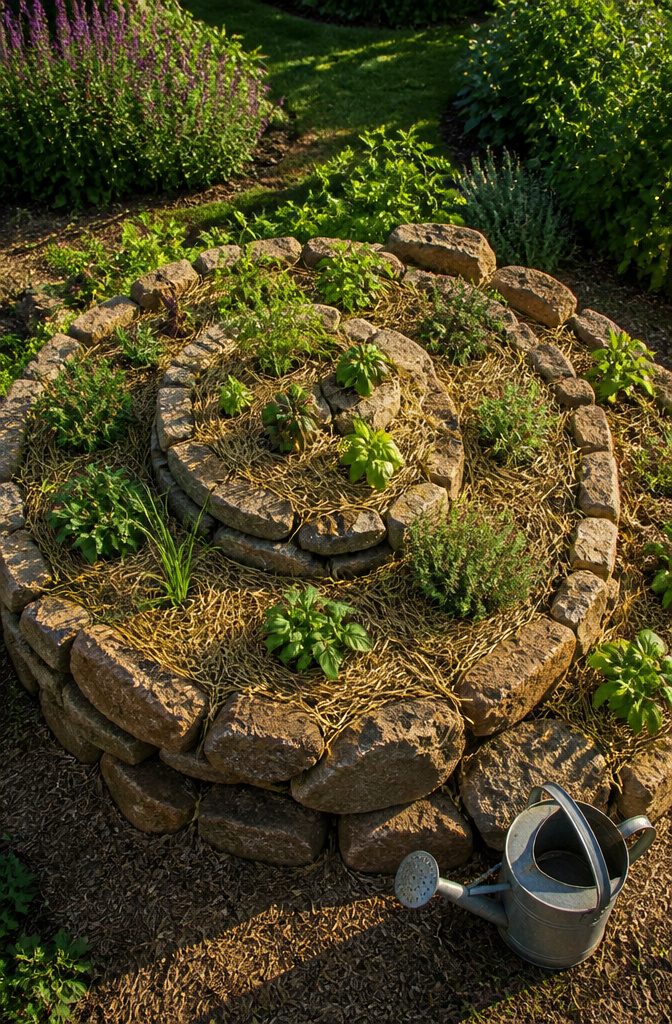
The last step locks in everything you built. A light layer of straw, shredded bark, or compost tucked around each plant keeps the soil from drying out too fast and suppresses the weeds that would compete with your herbs.
Upper levels dry faster, so those drought-tolerant plants need that mulch most, though it helps everywhere.
Watering is where the spiral repays your effort. Gravity becomes your irrigation system: soak the top, and water naturally flows down to nourish lower plants.
You will still need to hit those bottom herbs directly, but you will not saturate them the way you would in a flat bed.
Deep, less frequent watering works better than a daily sprinkle. Let the soil dry slightly between rounds, especially up top, or root rot becomes a real risk in the lower zones where moisture lingers.
What the Spiral Shape Does
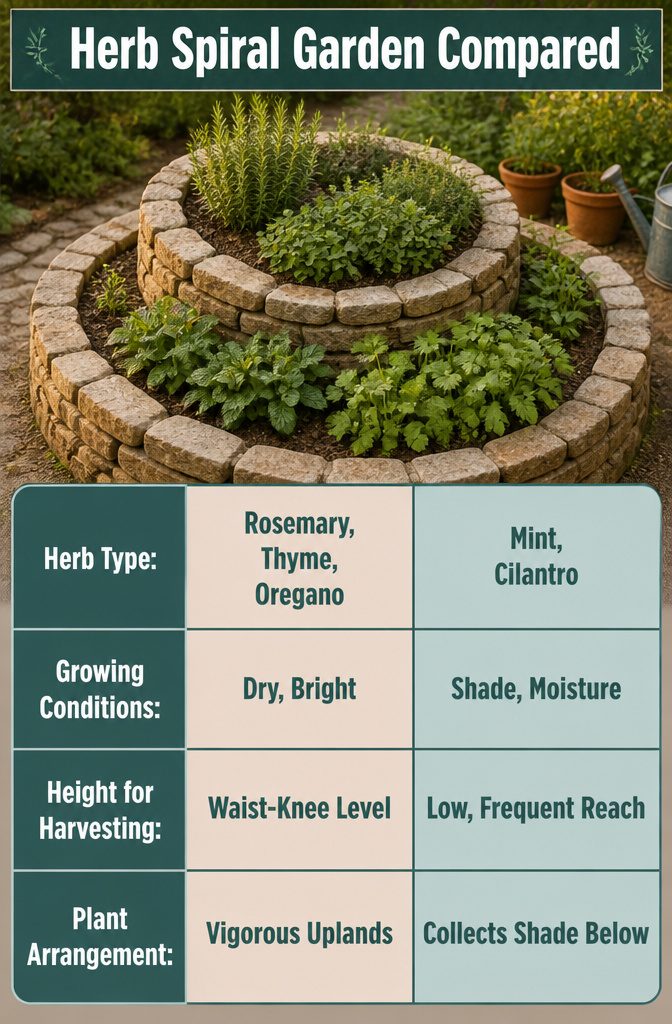
A herb spiral garden packs three or four growing conditions into a footprint barely wider than a patio table. The top sits highest and drains fastest, so rosemary, thyme, and oregano get the dry, bright conditions they actually want.
Walk the spiral down and the walls cast shade, moisture lingers longer, and suddenly you have a spot for mint and cilantro that would sulk in the same soil as the Mediterranean herbs.
That vertical shift matters for your back too. Most of the planting surface sits between knee and waist height, so harvesting and weeding happen without the bend-and-reach that flat beds demand.
The spiral wraps the growing space inward, which means every plant stays within an arm’s length of the path.
I would not build one wider than four feet for exactly that reason; past that, the center becomes a stretch and the convenience is gone.
The shape also lets you site companions where they do actual work.
Pest-repellent herbs like rosemary and sage can sit uphill from the tender-leaf plants that need protection, close enough to matter but in the dry soil that keeps them vigorous.
Materials You Need
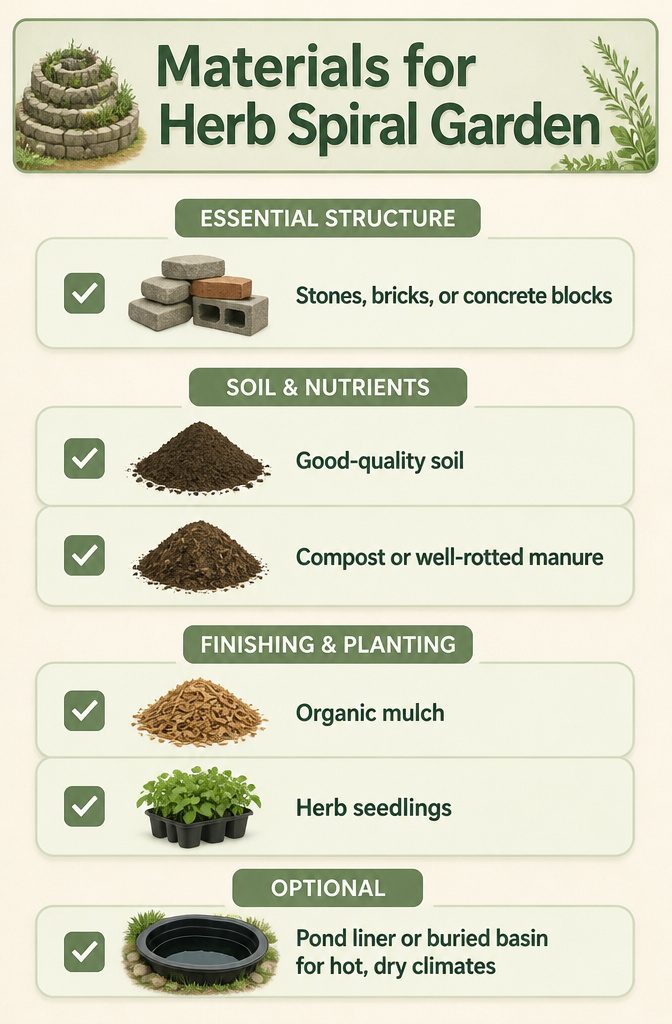
A herb spiral garden needs only what you’d gather for any small raised bed, stacked vertically instead of spread flat.
- Stones, bricks, or concrete blocks for the spiral walls. Dry-stacked fieldstone has the look most people picture, but standard bricks or cinder blocks work fine and line up faster.
- Good-quality soil, ideally a mix designed for herbs rather than generic topsoil. The spiral’s height means you’re buying more than a flat bed would need, so budget for that extra volume.
- Compost or well-rotted manure to mix in and feed the planting pockets.
- Organic mulch such as straw or wood chips to cap the surface after planting and slow evaporation from the exposed sides.
- Herb seedlings chosen for their light and moisture needs, since the spiral’s zones range from dry at the top to wet at the bottom.
Optional: a small pond liner or buried basin at the base if your climate runs hot and dry.
It catches runoff from the spiral and keeps the lowest tier consistently moist for water-loving herbs like mint or parsley. Without it, you’ll just water that zone more often.
Herbs by Spiral Zone
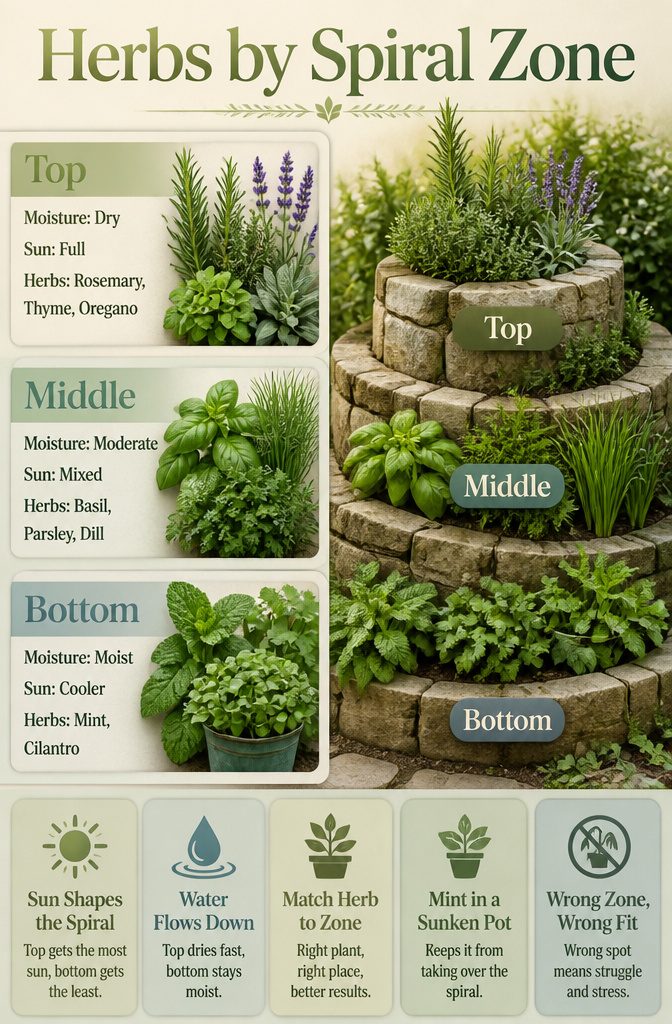
The top of an herb spiral garden dries out fastest and gets the most sun, which is exactly what rosemary, thyme, oregano, sage, and lavender prefer.
I would not try to force basil up there; it wants steady moisture and will sulk.
Down at the base, where water collects and shade lingers, mint, cilantro, lemon balm, and watercress do the work for you. The middle band is your flexible zone, and that is where I would put basil, parsley, dill, and chives.
| Zone | Moisture | Sun | Herbs |
|---|---|---|---|
| Top | Dry, fast-draining | Full, intense | Rosemary, thyme, oregano, sage, lavender |
| Middle | Moderate, balanced | Mixed | Basil, parsley, dill, chives |
| Bottom | Moist, retained | Cooler, shadier | Mint, cilantro, lemon balm, watercress |
Mint belongs in a pot sunk into the soil unless you want it to own the whole spiral by August.
The physical structure does the microclimate work; your only job is to match the plant to the spot. I would rather skip an herb than plant it in the wrong zone and watch it struggle.
Frequently Asked Questions
What is an herb spiral garden?
An herb spiral garden is a compact, vertical raised bed built in a spiral shape, usually with stones or bricks, that creates multiple growing conditions in a small footprint.
The spiral rises toward the center to about 3 feet, which naturally produces drier soil at the top, moderate moisture in the middle, and wetter conditions at the base.
This lets you grow sun-loving Mediterranean herbs alongside moisture-tolerant plants in one structure.
How do you build an herb spiral?
Mark a spiral 5–6.5 feet across using a string tied 2.5–3.25 feet from a center stake, then build dry-stacked stone or brick walls starting at the outer edge and spiraling inward with the planting bed about 1.6 feet wide.
Layer cardboard over the footprint for weed suppression, add gravel or broken pottery at the bottom of each section for drainage, and fill with soil and compost as you stack.
The outer ring stays lowest at one or two stones high, with walls climbing higher toward the center.
What herbs should I plant in an herb spiral?
Plant rosemary, thyme, oregano, sage, and lavender at the top where drainage is fastest and sun is most intense. Basil, parsley, dill, and chives belong in the middle band with moderate moisture and mixed light.
Mint, cilantro, lemon balm, and watercress go at the base where water collects and shade lingers, though mint should stay in a pot sunk into the soil to prevent it from overtaking the whole structure.
How to make a DIY herb garden?
An herb spiral is one of the most space-efficient DIY herb gardens you can build in a weekend using stones or bricks, soil, compost, and seedlings.
The spiral shape does the hard work of creating microclimates automatically, so you only need to match each herb to the right zone and keep the bed within arm’s reach of your kitchen door.
No mortar or professional construction skills are required; dry-stacked walls backfilled with soil hold themselves in place.
What herbs shouldn’t be planted together?
The biggest pairing mistake in an herb spiral is planting mint directly in the soil with other herbs, since it spreads aggressively and will dominate the bed by midsummer.
Beyond that, the spiral’s zones already separate incompatible plants: Mediterranean herbs like rosemary and lavender that need dry conditions should never share soil with moisture-lovers like cilantro or watercress, which is why the spiral structure exists.
Each herb gets the conditions it actually wants instead of compromise soil.





