
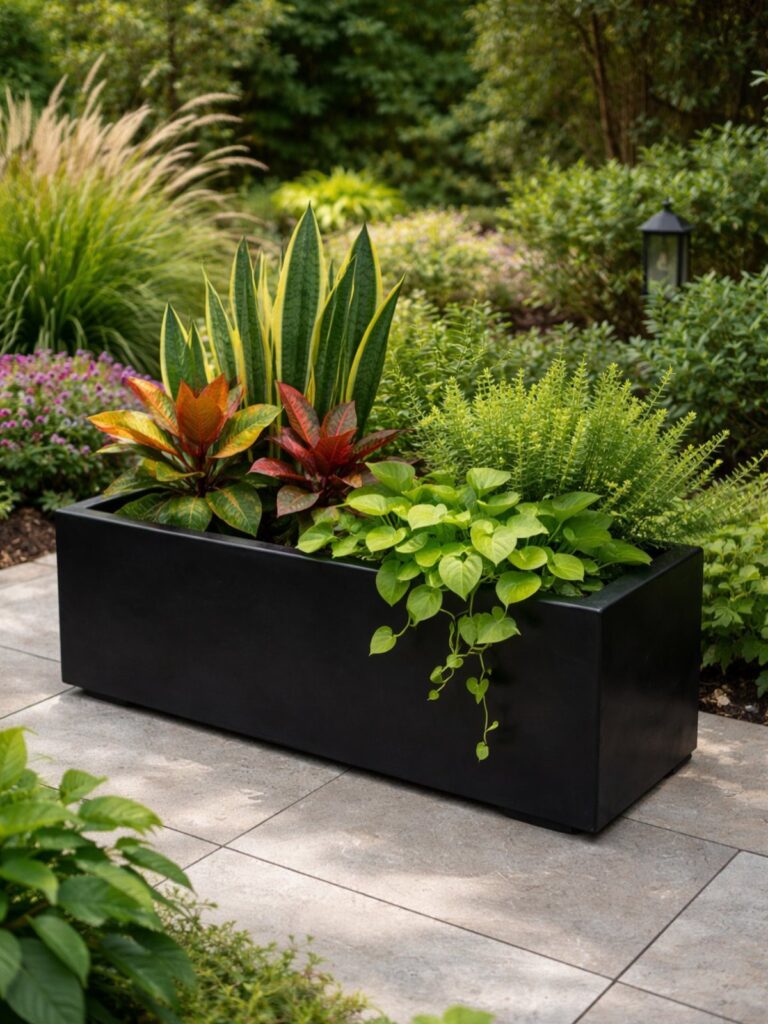
The right modern front of house idea depends on whether you are redoing one element or the whole approach, because these ideas run from a single afternoon painting a door to installing a security gate before the stone pillar goes up.
I would start with what my actual weekends and budget allow, then match the material to the climate, whether that means agave in warm zones or hardy yucca where frost comes hard.
[link-whisper-related-posts]1. Outdoor Lighting
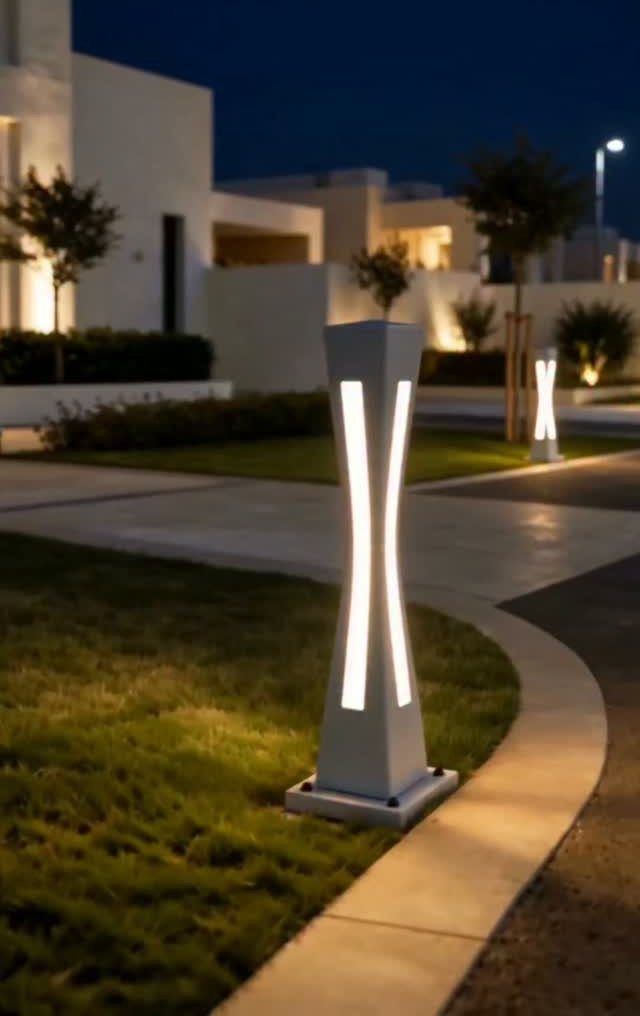
Bollard lights along a walkway do 2 jobs: they keep you from tripping in the dark, and they give the front of your house a clean, intentional look after sunset. An hourglass shape reads modern without trying too hard.
I would check the height before ordering.
Most path lights land between 24 and 36 inches; too short and they disappear, too tall and you are lighting your shins. LED with a warm color temperature, around 2700K, keeps the glow from looking like a parking lot.
Solar is easier to install, but wired gives you consistent brightness through winter. I go wired for a main path and solar only for accents I do not mind being dim by February.
2. Landscaping with Containers
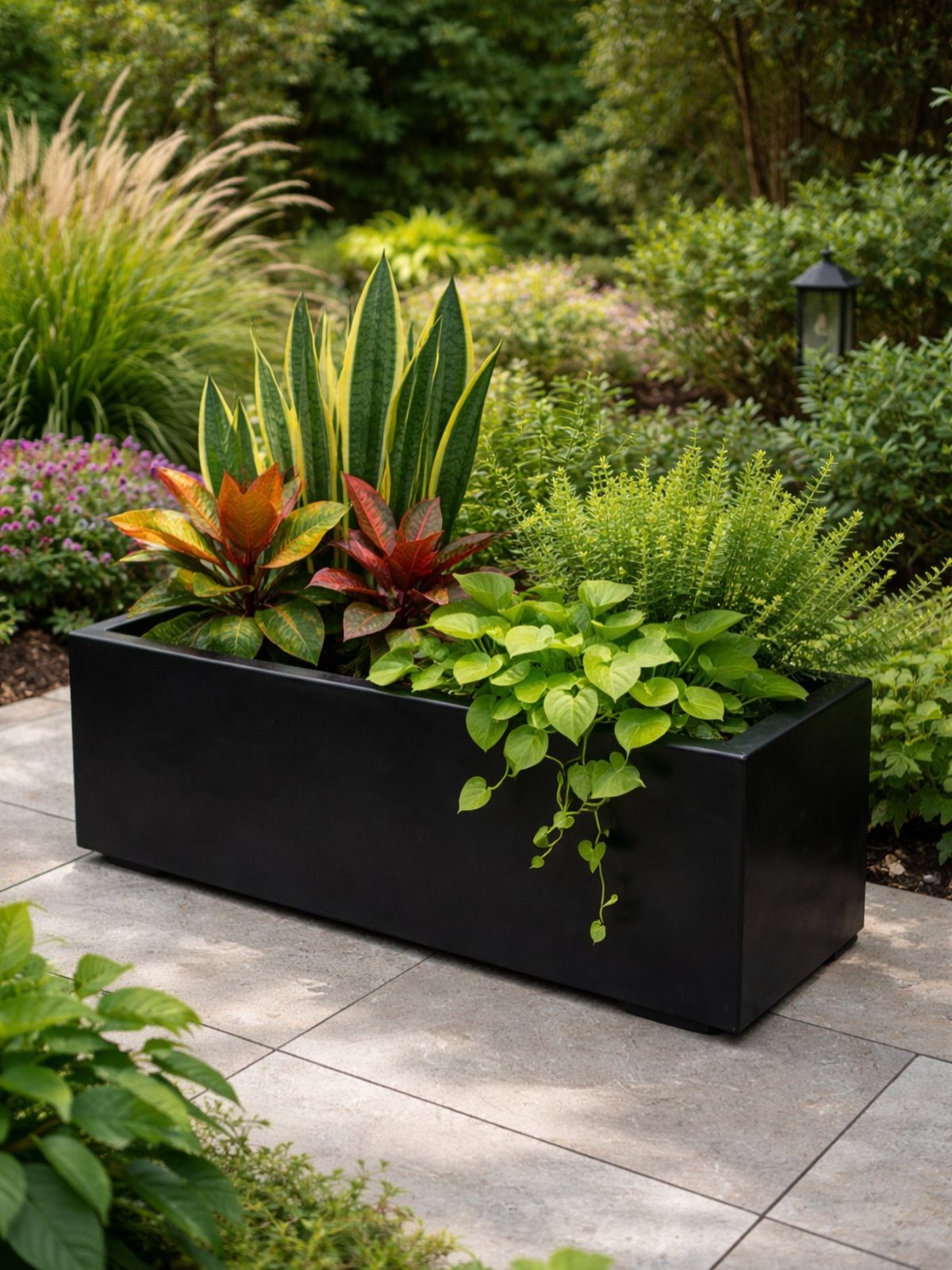
A black rectangular planter against stone or tile gives you structure without commitment. You can move it when the season changes or when you get bored, which for me happens often enough that permanent plantings feel like a commitment.
Snake plants, crotons, and trailing greenery mixed together mix heights and leaf shapes so the arrangement stays interesting even without flowers.
That combination works because the snake plants give you height that stays upright, the crotons add color that does not rely on flowers, and the trailer softens the edge.
For a front-of-house spot, I would size the planter to at least 30 inches long so it does not look like an afterthought.
Drainage holes are non-negotiable; standing water rots roots faster than you would think. I have killed enough plants to learn that the hard way.
3. Sculptures, Bird Baths

Three rusted metal bowls on stakes, set at different heights among low shrubs, give a front garden something to look at in winter when the plants have quit.
The natural steel weathering means the color keeps shifting; the maker notes they also catch rain and give birds a place to bathe.
I like this because it does not read as lawn ornament. The thin stakes keep the visual weight low, and the rust finish ties in with mulch, bark, or any natural stone you already have.
Arrange them in a loose triangle, not a straight line, and push the tallest one slightly off center. The set is three pieces; anything less would look like you lost one.
4. Use Hedges for Privacy
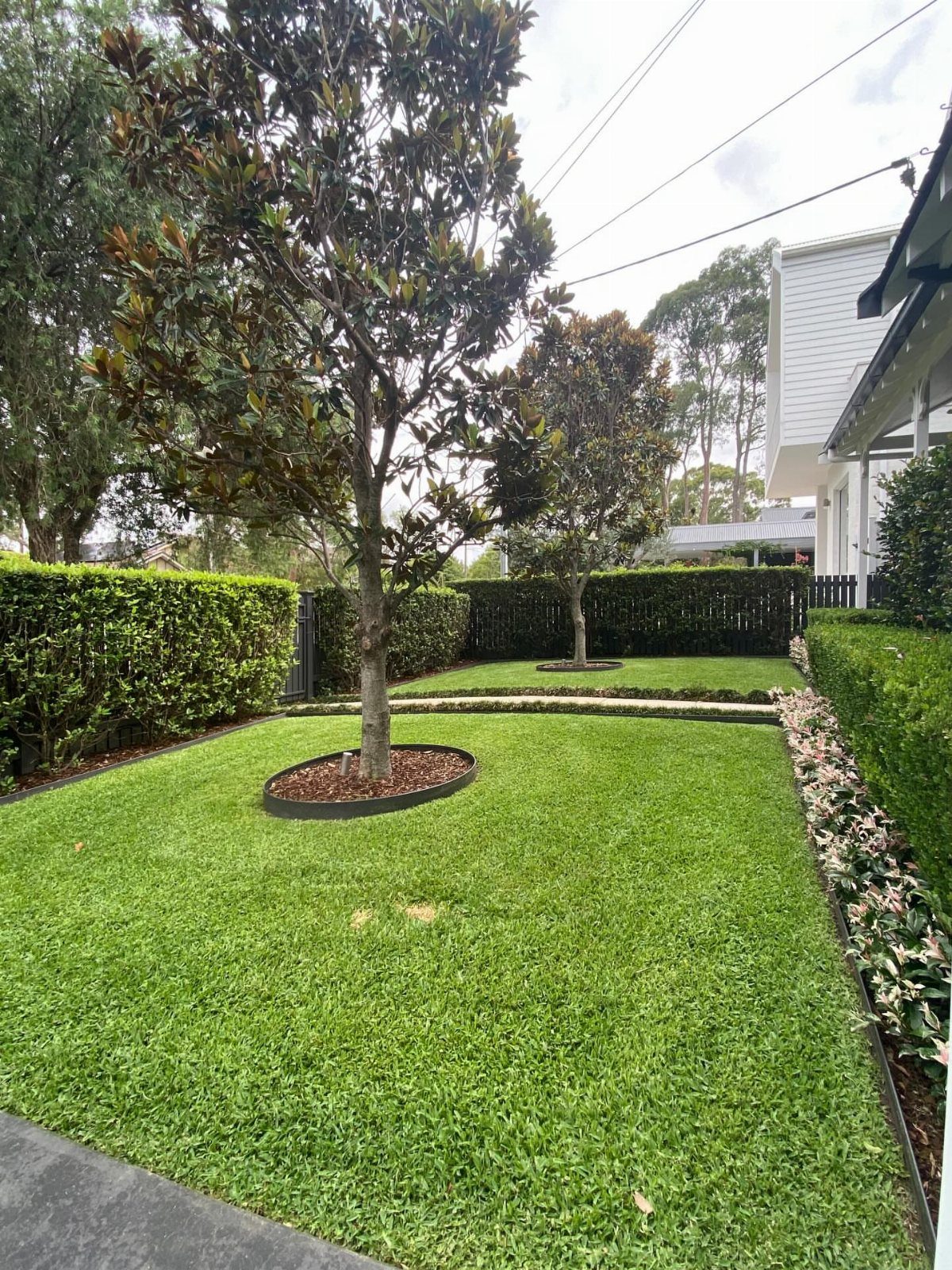
Tight-trimmed hedges around a lawn give you a green wall that fences cannot match. They define the property line and block the view from the street, and when aligned with the facade they frame the house like a picture.
The upkeep is the trade-off. Boxwood or yew, common choices for this look, need several trims a year to stay sharp, and a hedge that tall takes time or money.
I would not plant one right up against the sidewalk; the salt and compaction from winter plowing will punish it.
For a faster start, buy larger specimens already chest-high or taller, and plant in a trench rather than individual holes so the roots interlock sooner.
5. Cladding Materials
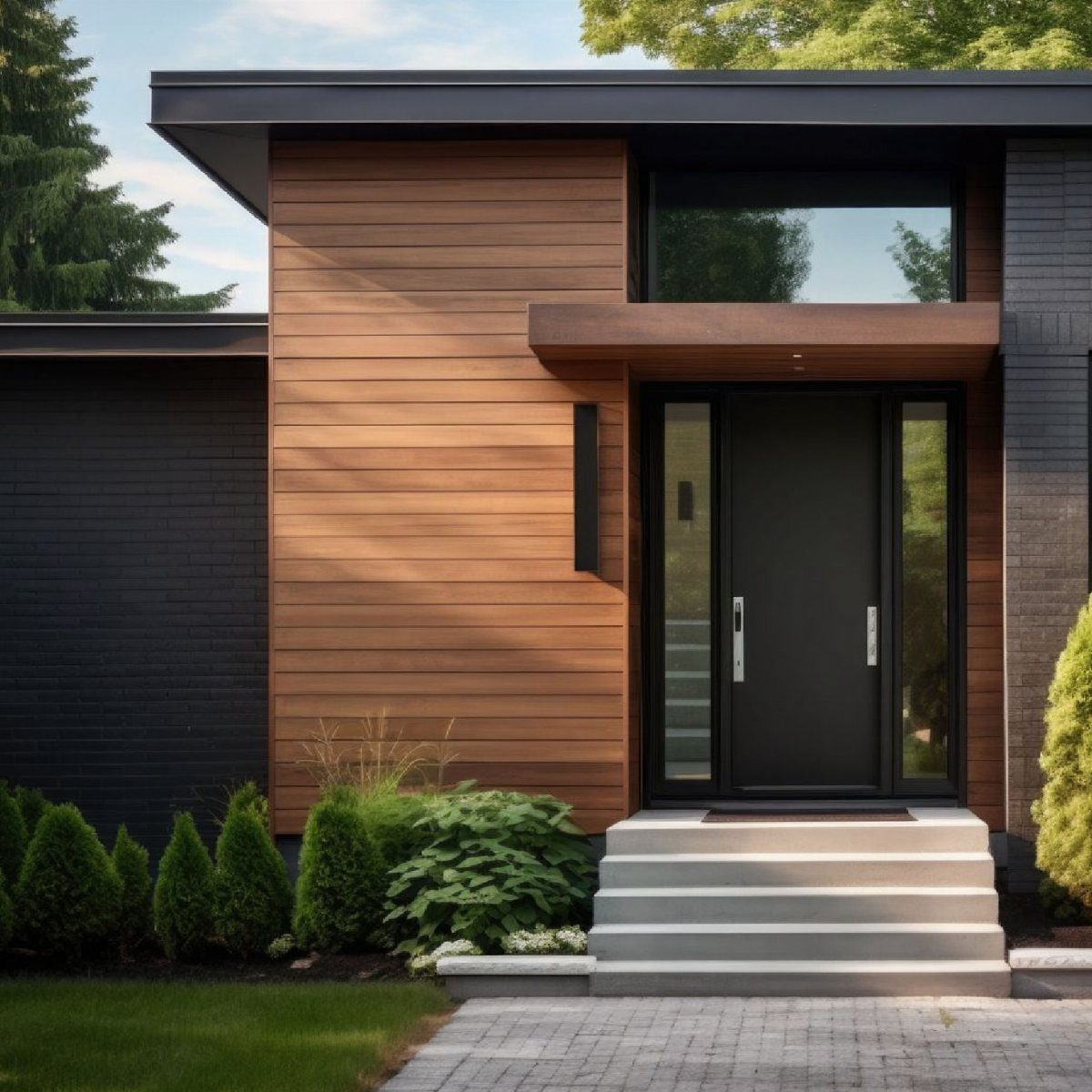
Horizontal wood siding next to dark brick on the same facade breaks up a flat wall without adding decoration. Running the wood the long way stretches the eye and makes the house look wider from the street.
Mixing materials works when you keep the palette tight.
I would check the wood species and finish before committing. Cedar or redwood holds stain well, but horizontal boards trap more water than vertical siding, so the sealant matters.
The gap where wood meets brick needs flashing behind it, or water will find that joint in year five and you will be patching.
6. Porch Swing
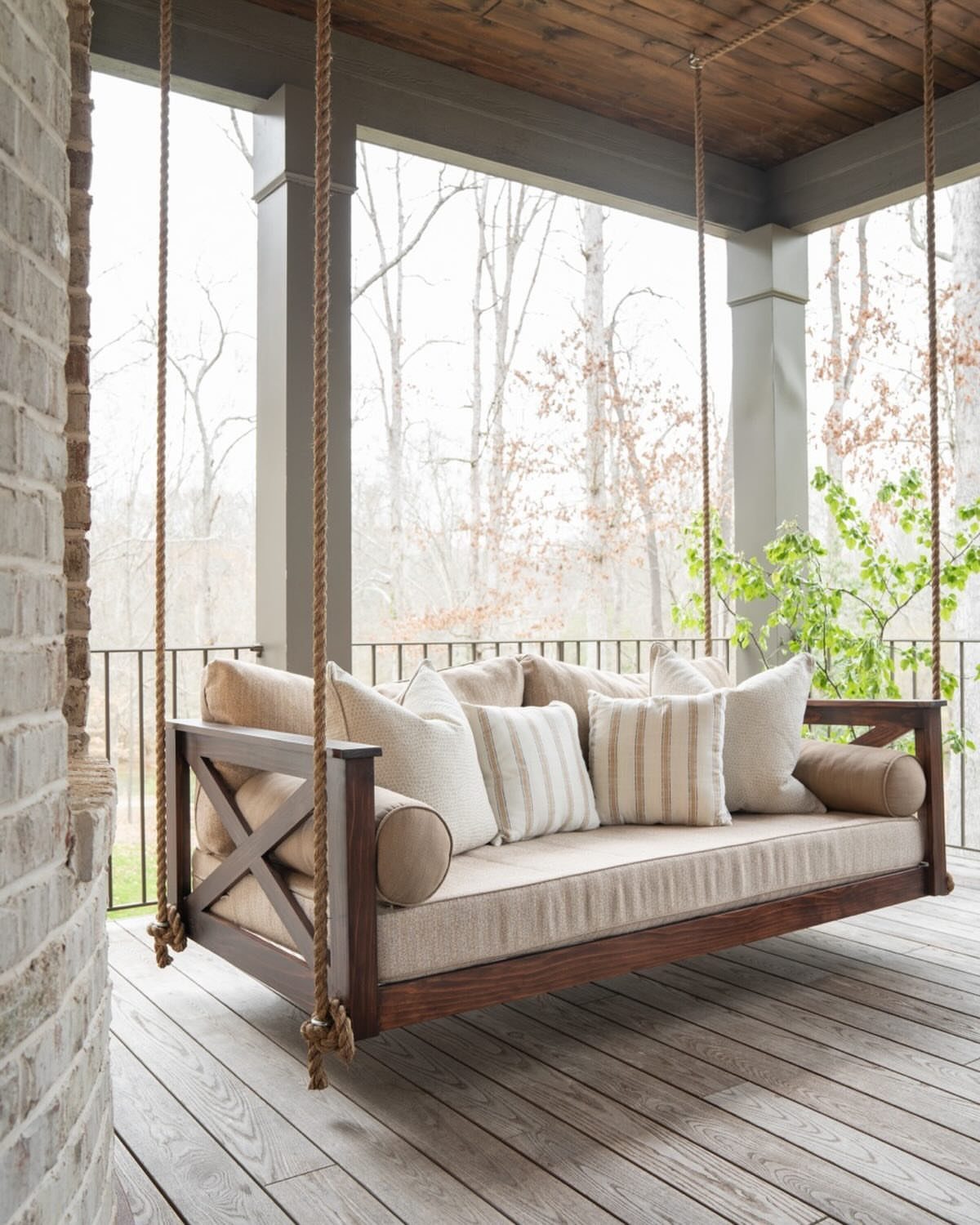
A swing deep enough to lie down on, hung with rope on a covered porch, turns a pass-through space into somewhere you actually stop. Neutral cushions let the wood and the view do the work.
Before you buy, test whether your porch ceiling can take the load. A swing bed plus 2 adults is heavy; a standard joist may hold it, but I would add a blocking piece between joists to spread the weight.
Rope looks better than chain, but it stretches and rots; I use polyester rope rated for outdoor use and plan to replace it on a regular schedule.
The swing needs clearance behind it and enough height off the deck to swing without kicking the floorboards.
7. Modern Landscape Design with Signature Plants
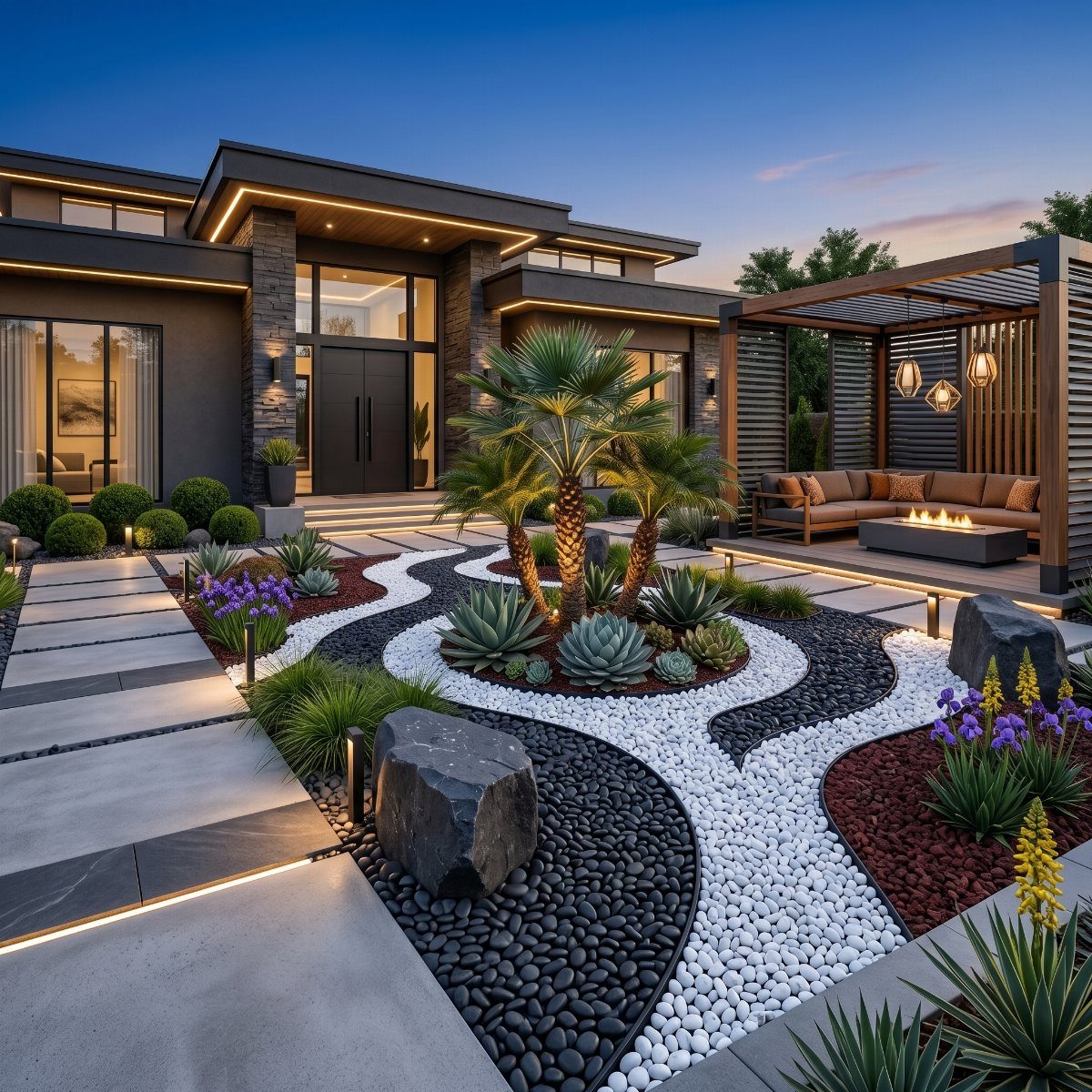
Palm trunks and agave rosettes do the sculptural work so you do not have to build it.
A white and black stone swirl reads as deliberate, not accidental; it takes raking to keep those edges sharp, and weed barrier underneath or the maintenance doubles.
I would not plant agave anywhere a child runs barefoot; the spines are real.
For a cooler climate, substitute hardy yucca or ornamental grass that holds a similar silhouette without the frost protection hassle. Integrated path lighting is worth the wiring cost here, since the plants themselves look flat after dark without it.
8. Colorful Door
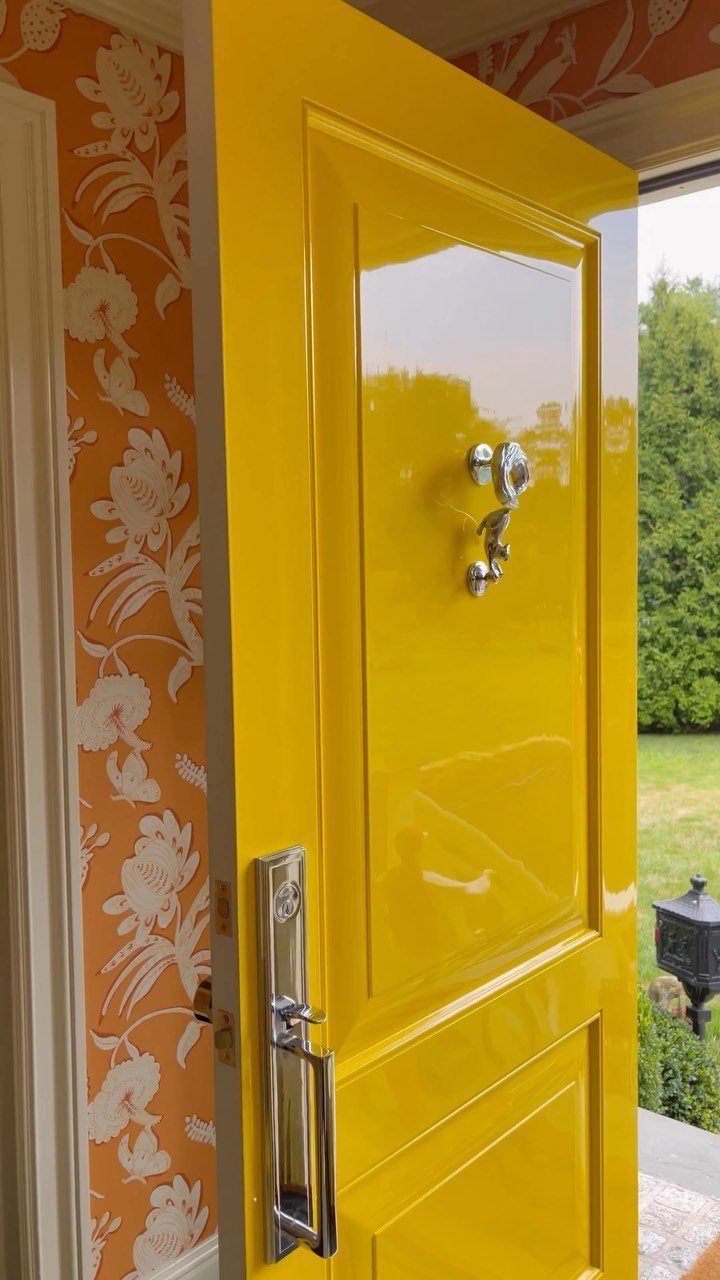
A yellow this saturated works because the house around it stays quiet. Chrome hardware picks up the gloss without competing, and that restraint matters: a loud door plus a loud house reads carnival, not modern.
I would test a sample on the actual door before committing.
Paint reads different in morning shade and afternoon sun, and a color this bold is painful to repaint if you miss. Gloss level matters too; high-gloss like this shows every dent and is harder to touch up than satin.
For a rental or a first home you might sell, this is an afternoon project that comes off with primer if the next buyer hates it.
Yasmine El Sanyoura, Opendoor’s home design expert based in Toronto, Ontario, recommends doing so for a quick, low-budget project. “Sherwin Williams’s 2022 Color of the Year, Evergreen Fog, has been a favorite for a simple and effective update,” El Sanyoura says.
9. Front Yard Xeriscaping
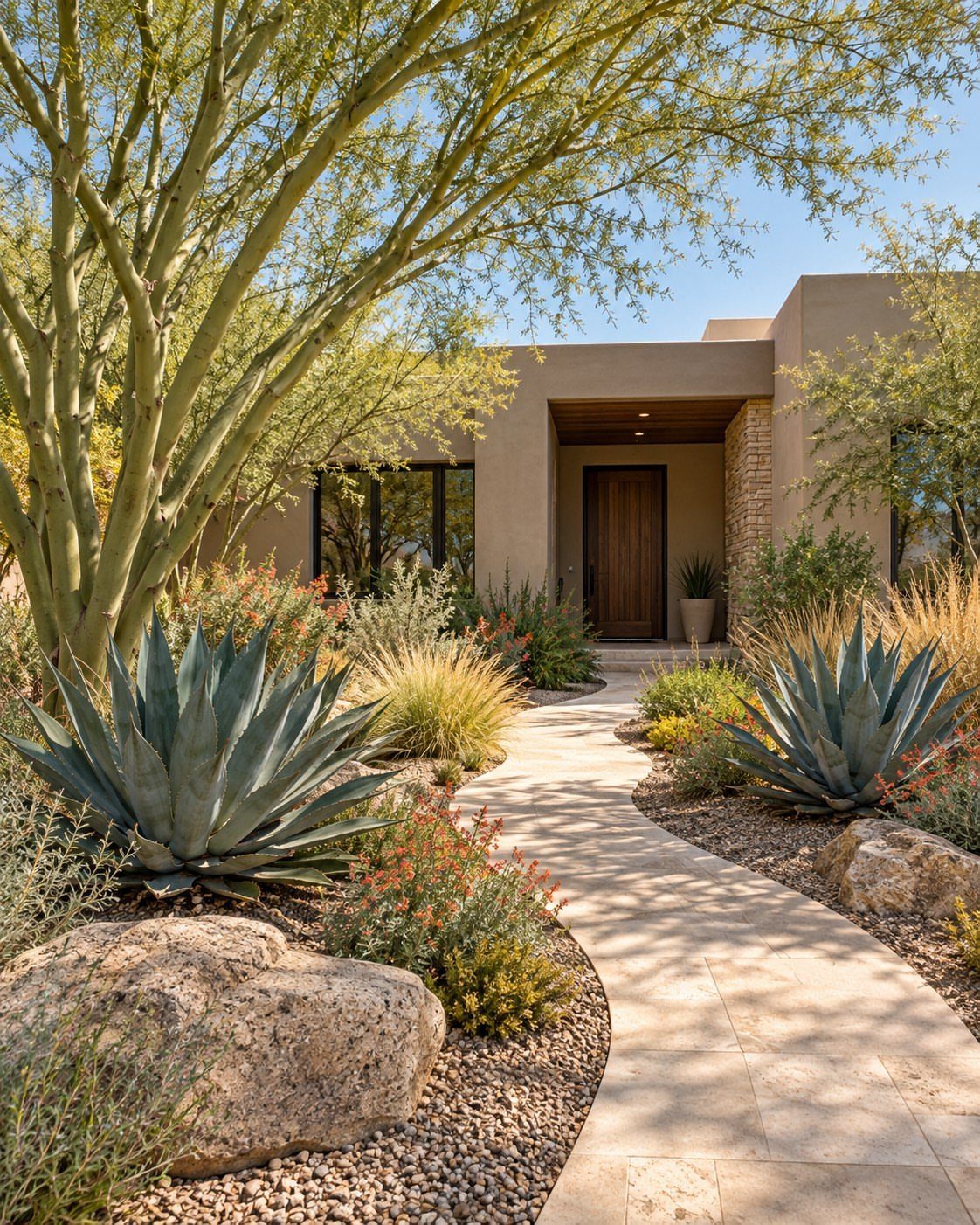
Gravel, boulders, and plants that evolved for dry air add up to a front yard that does not ask for weekend watering. A curved path softens what could feel harsh; straight lines with this palette read parking lot.
I would check local codes before ripping out grass. Some municipalities still require minimum lawn percentages or classify gravel as impervious surface for runoff rules.
Drainage under the gravel layer is the step that prevents weeds; compacted road base, then landscape fabric, then your rock. Skip the fabric and you will be pulling seedlings from mud in year two.
10. Front Door with Planters
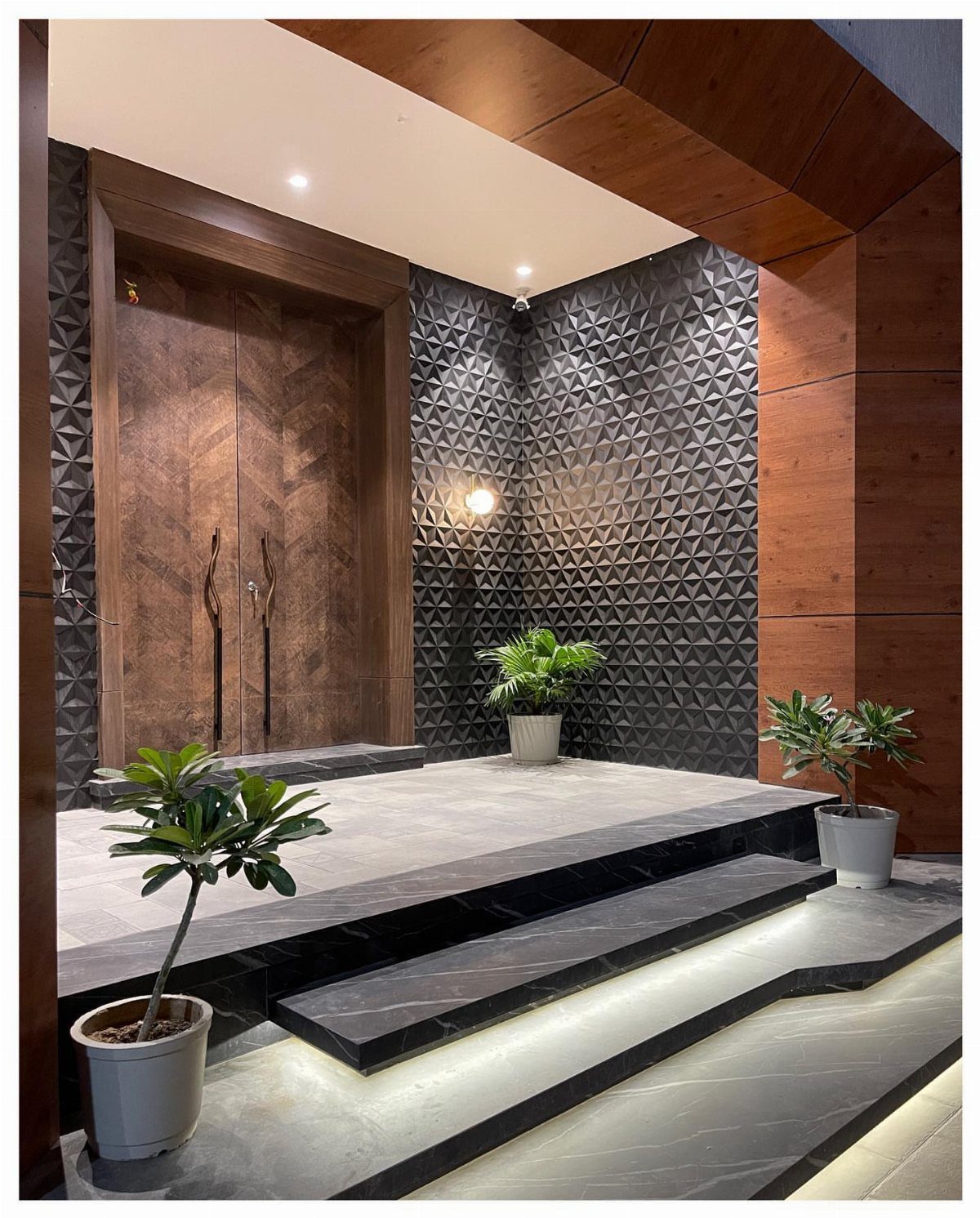
White pots against black tile give the entry its rhythm; the plants are almost secondary. Under-lit marble steps do the heavy lifting of making an entry feel designed, not decorated.
For a version on a real budget, I would skip the integrated lighting and set a single LED uplight on a timer against a plain pot.
The 3D tile behind these planters is what makes the photo work; without that texture, 3 pots in a row look like a dentist’s office.
Scale the pot to the door width, not the step depth. Too small and it looks like you are waiting for the plant to grow into the space.
11. Install a Modern Mailbox
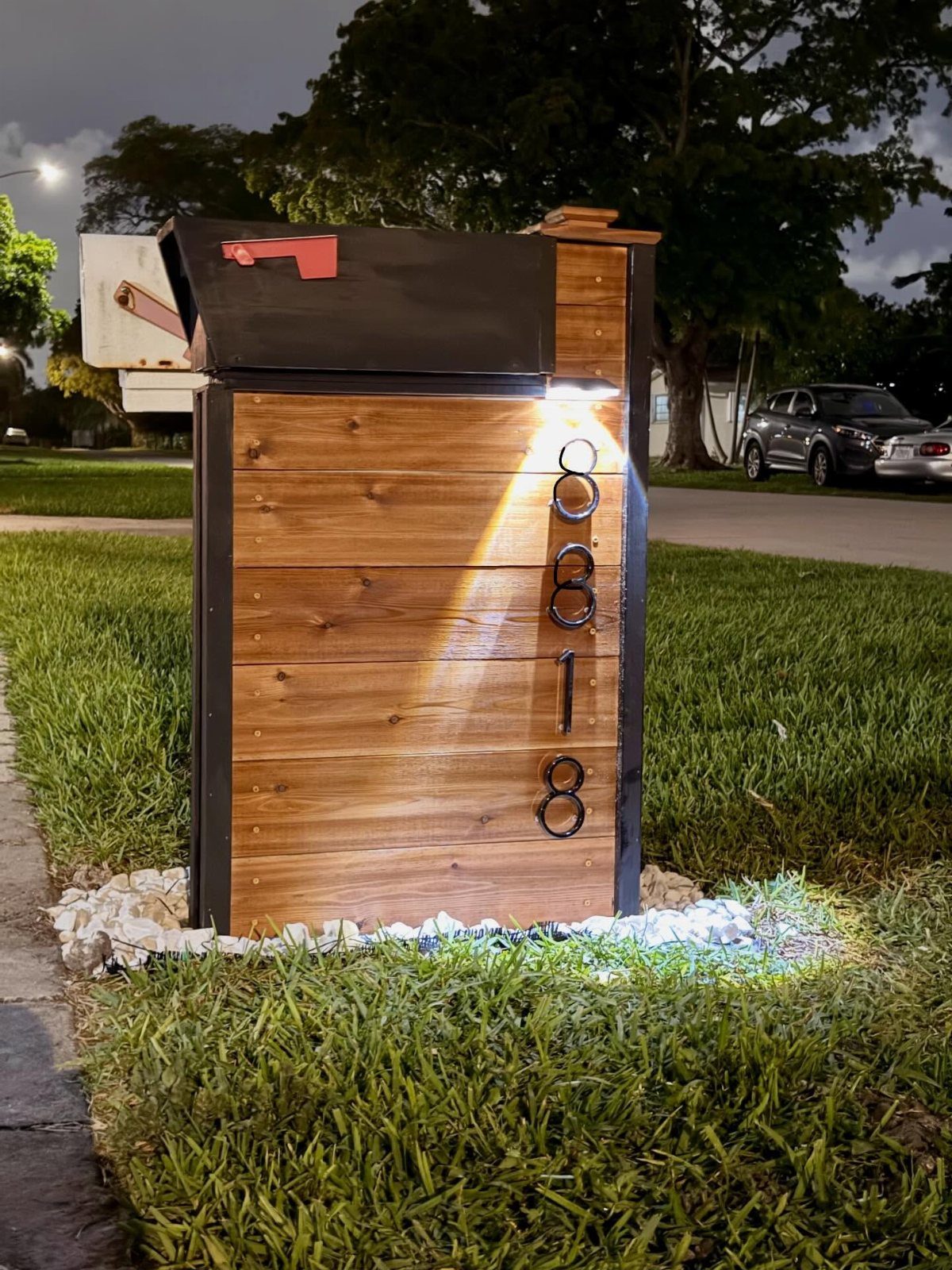
Horizontal wood slats and black metal frame turn a mailbox into something that belongs to the house, not the post office.
A downlight is the detail that makes a modern mailbox legible after dark; house numbers without light are invisible to visitors and delivery drivers.
I would mount the box at standard carrier reach to the slot, and set the post in concrete below frost line or it will lean by spring.
The wood needs sealing; horizontal grain traps more water than vertical, same problem as horizontal siding.
I would use ipe or another dense hardwood, or accept that pine will gray and split within a few years and plan to replace it.
12. Modern Black and White Facade
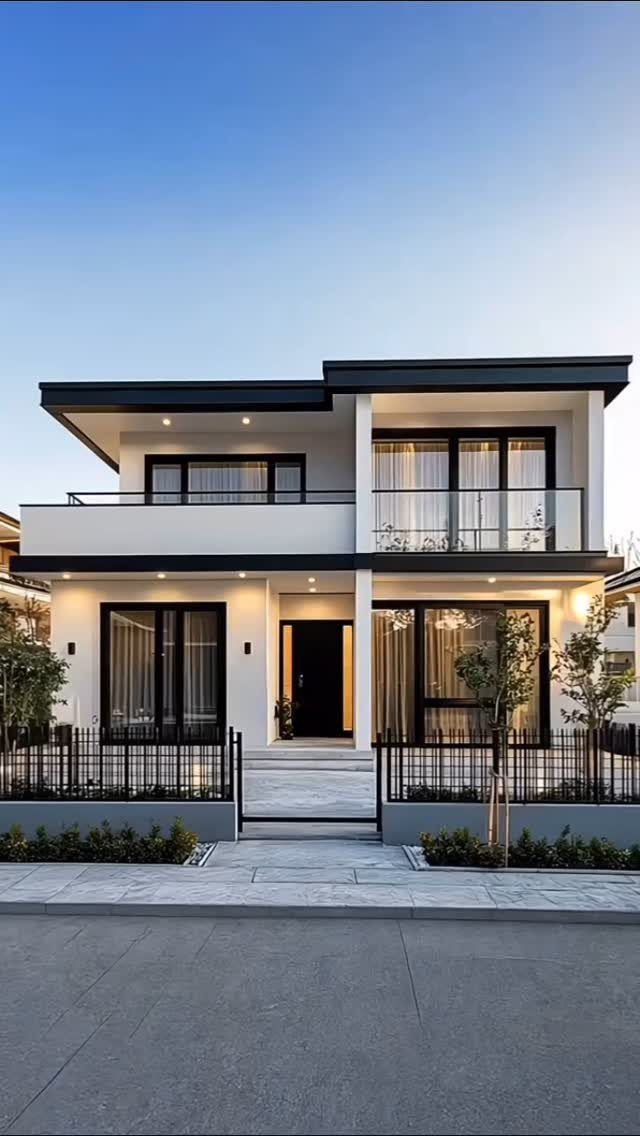
Black window trim on white render gives a house the graphic quality of a line drawing. A black fence extends that language to the property edge, so the house and its boundary read as one decision.
I would not add a third color anywhere prominent; the power of this look is the restraint. The metal fence is thin-profile, which matters, because a heavy black fence reads fortress where a light one reads frame.
For a first home, painted brick or fiber-cement siding in white holds the look for less than rendered stucco, and you can touch up damage yourself without matching a custom finish.
13. Geometric Stone Walkway
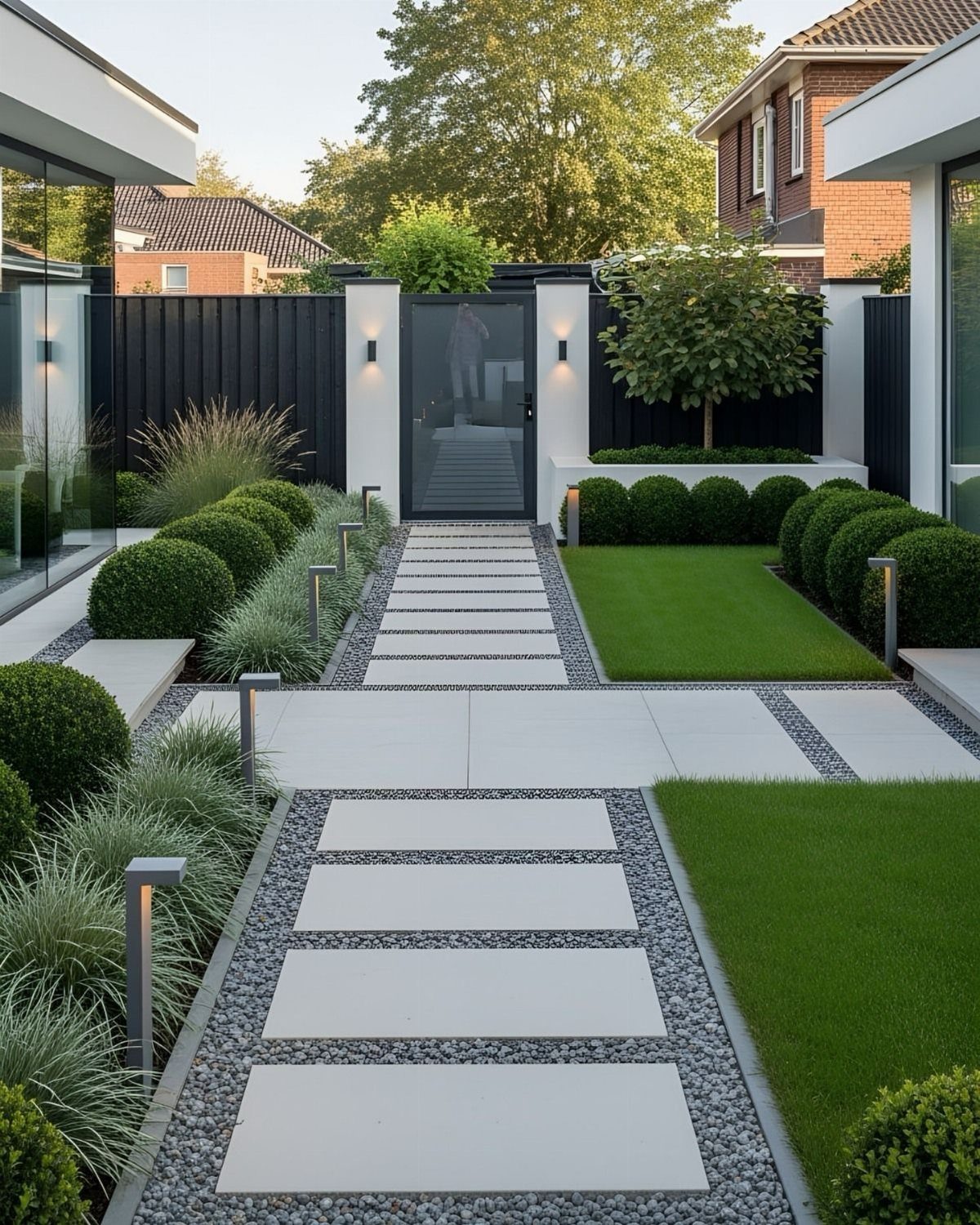
Rectangular slabs set in gravel give you a path that stays neat without perfect pitching skills; the gravel fills the gaps so water drains and the stones do not rock.
I would keep the slab size consistent and space them one slab-width apart so the stride feels natural.
The boxwoods on the edges need the same clipping schedule as any hedge; if you want the look without that labor, sub in rounded boulders or even mounded grasses.
This suits a flat approach better than a slope, where gravel washes and slabs shift.
14. Textured Grey Stone Exterior
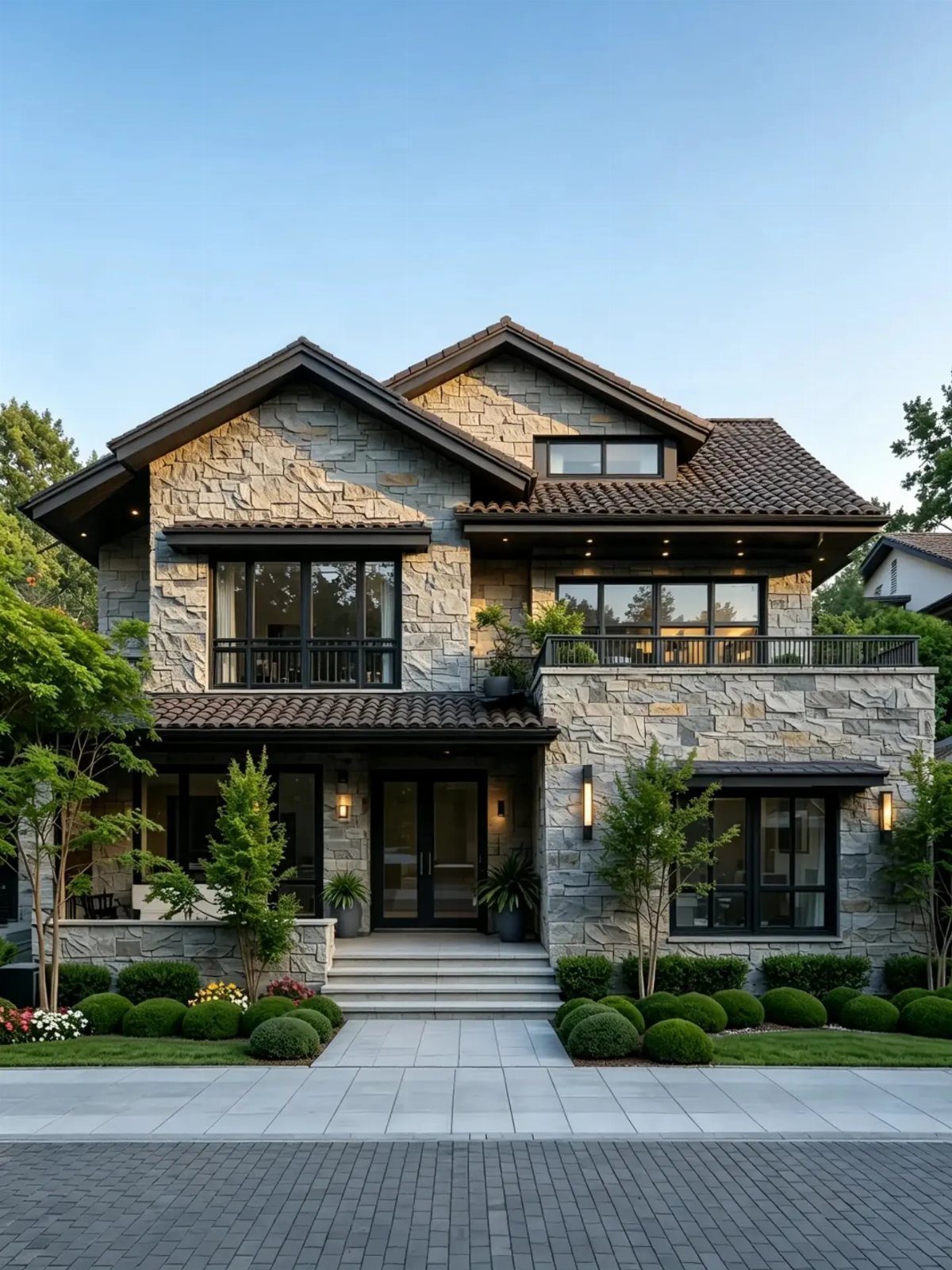
Stone cladding on both stories gives a house weight that painted siding cannot fake, and the dark trim keeps the windows from reading as holes punched in a wall.
The roof tile and the stone share a grey value, which is what makes this look unified rather than busy.
The cost is the barrier. Real stone veneer runs higher than fiber-cement or vinyl, and the install needs a mason, not a carpenter.
I would check whether the stone is actual full-thickness stone or a veneer system; veneer is lighter on the structure and the budget, and from the street the difference is invisible.
Either way, the wall behind it needs proper drainage channels or moisture will sit against sheathing you cannot see.
15. Live-Edge Wood Front Door
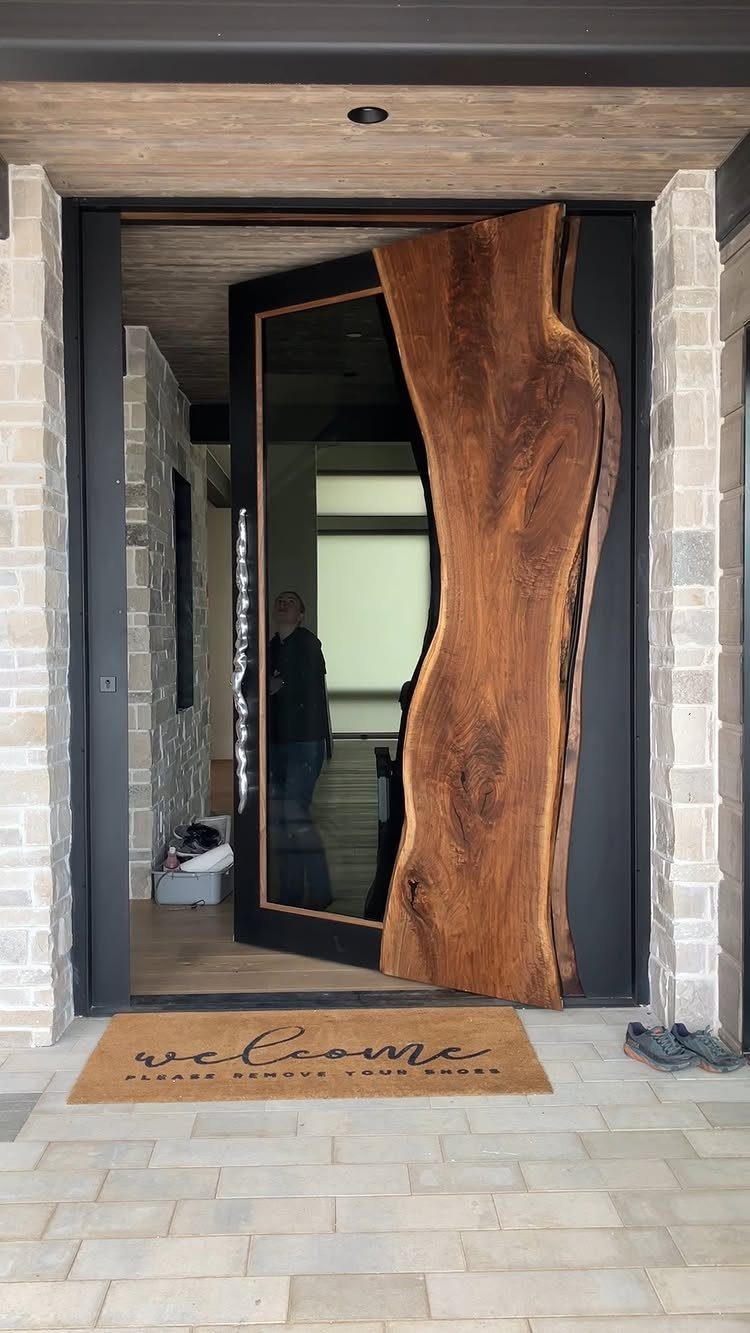
A pivot hinge lets a door this heavy swing smoothly; standard hinges would sag in 2 seasons.
The live-edge slab keeps the tree’s outer contour, so no two are identical, and the glass beside it borrows daylight into the entry without sacrificing privacy if you use frosted.
I would ask how the wood is stabilized. A slab this wide checks and cracks as it seasons; kiln-drying and sometimes a resin fill or butterfly keys keep it flat.
The metal frame is doing structural work here, not just trim. For a climate with hard freezes, I would confirm the seal details; wood moves more than steel, and the gap between them is where air leaks start.
16. Modern Security Gate and Entry
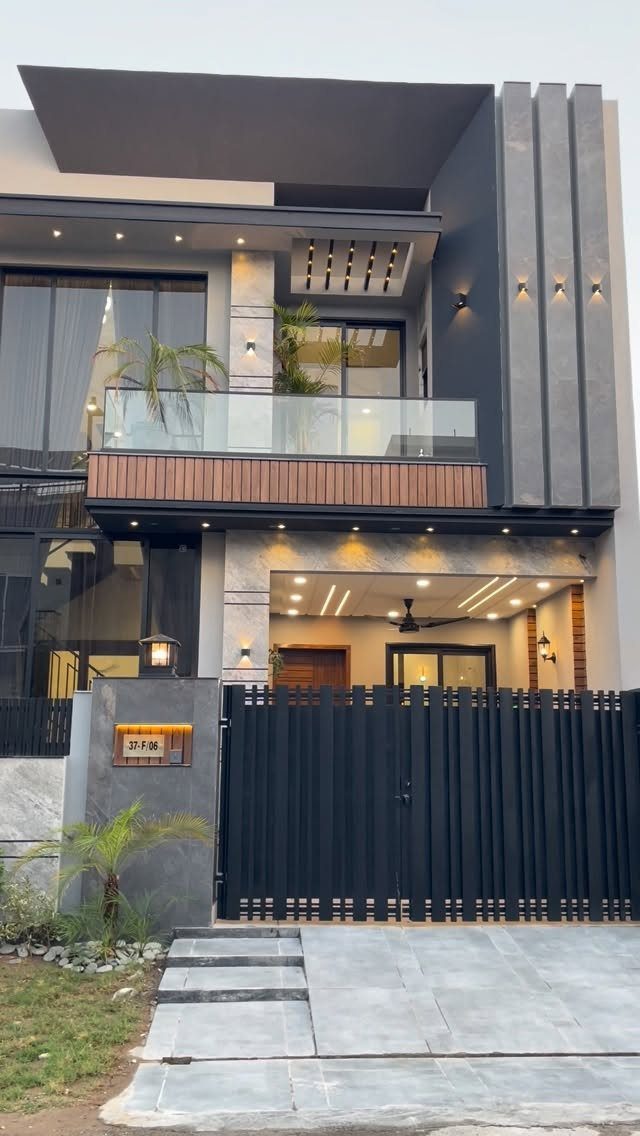
Vertical slats read lighter than a solid panel while still blocking the view; from inside, you see out between them, which is the point of a gate rather than a wall.
The stone pillar with an integrated number plate turns a functional requirement into the design’s anchor.
I would plan the automation early. A gate this tall is heavy, and a manual latch gets old fast in rain or dark.
The footing for the pillar needs to extend below frost line same as any structural post, and the wiring for the light and any opener has to run in conduit before the stone goes up. Retrofitting that is expensive digging.
17. Black Stone Entry Steps
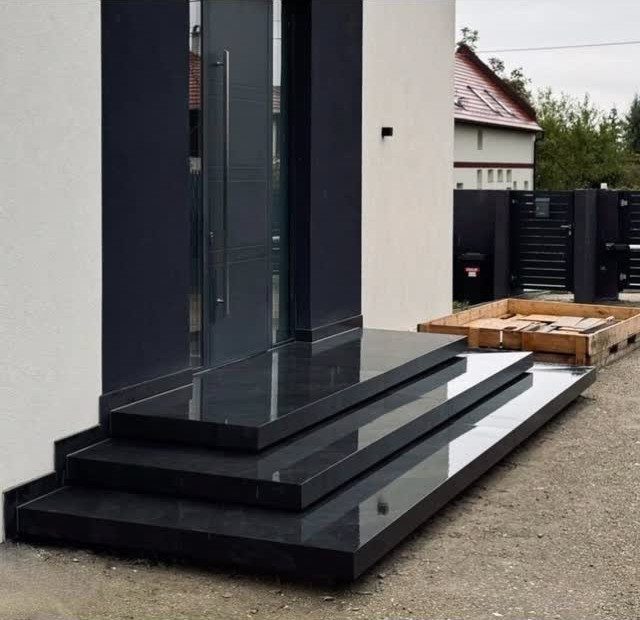
Polished stone reflects enough light that the steps read even after dark without separate path lighting, though I would still add a downlight at the door for the keyhole.
The contrast with the white wall is what makes this entry photograph well; on a darker house the steps would disappear.
Black granite in a polished finish is slippery when wet or frosted. I would check the slip-resistance rating before ordering; a honed or leathered finish trades some gloss for grip, and for a northern climate that trade is worth it.
The overhang on each tread, visible here as a thin dark lip, sheds water and gives the shadow line that separates the slabs visually.
18. Stucco and Built-in Bench Entryway
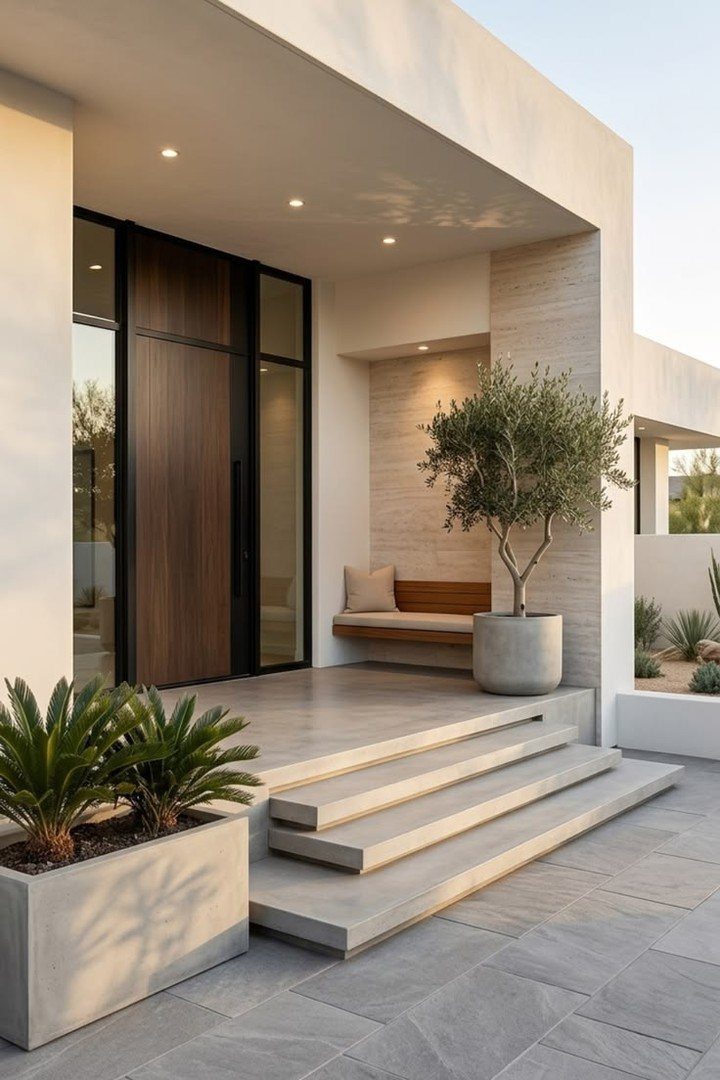
A bench recessed into the wall turns a passage into a pause; the olive tree in a pot beside it softens what might otherwise read as a courtyard without furniture.
The floating concrete steps keep the ground plane open, which matters in a small entry where a full stoop would feel cramped.
The bench needs a slope, barely visible, to shed rainwater; flat tops puddle and rot wood.
I would build it from a dense hardwood like ipe or sealed teak, not pine, since even a covered alcove still sees moisture and temperature swings.
The stucco color here is warm, almost sand; a cooler grey would read industrial with the concrete, so sample before the crew covers the lath.
Choosing the Right Plants
I start with the climate, not the catalog. A plant that thrives in Portland will sulk in Phoenix, and nothing kills curb appeal faster than replacements every spring.
The ASLA figure, 20% or more value increase from professional landscaping with plants, is worth remembering when you budget; it tells you where to put money if you are selling.
For flower beds, I would mix structure and color: roses or hydrangeas for bulk, petunias or hostas for fill.
In planters, salvia, lantana, calibrachoa, and succulents survive the confinement and give you the longest season for your dollar. For screening, boxwoods and arborvitae grow slow but stay green; ornamental grasses move in wind and need less water.
Low-maintenance is not no-maintenance. Ornamental grasses skip the lawn mower but still want an annual cutback.
Succulents and waterwise shrubs suit arid zones where turf is banned or impractical. Check your HOA or city rules before you rip grass out; some still require minimum lawn percentages.
Soil in former lawn is usually compacted and hungry.
Amend before you plant, or your investment starves in year one. Multi-season interest, foliage color, berries, bark, keeps the yard from going flat after bloom season ends.
Maintaining Your Front Yard
A regular lawn demands weekly mowing, sprinkler bills, and in dry regions the water board may fine you for keeping one alive.
Some cities and HOAs still mandate minimum lawn coverage, so verify before you convert. If you keep turf, mow regular and reseed patches fast; bare dirt reads neglect from the street.
Ornamental grasses stand in for turf and never need a gas mower, though I still run a string trimmer through mine once each spring.
Gravel and permeable pavers drain better than solid concrete, but the base matters. Check soil drainage in planting beds too; compacted dirt starves roots and needs amendment before anything goes in.
Swap out whatever devours your Saturdays as you figure out what your yard really costs in hours and water. The goal is the look you want on the schedule you will actually keep, not the one you imagine in March.
Frequently Asked Questions
How do I make the front of my house look more modern?
Clean lines and a tight color palette do the heavy lifting. I would mix materials on the facade, like horizontal wood siding against dark brick, and keep the palette to 2 colors max.
Dark trim on a light body reads graphic and intentional, and updating the walkway to rectangular slabs in gravel connects the landscape to the door without fuss.
What are the trends for home exterior design in 2026?
Minimalist lines, mixed materials, and bold but controlled color are where the look is heading.
Sustainable choices factor in too: drought-tolerant planting, permeable hardscape, and dense hardwoods that last without replacement. Black-and-white facades and integrated lighting are specific moves that keep reading modern rather than dated.





